

The Canoe Country Angler * Vol. 4
July 17, 2025 10:50 amTop 3 Takeaways from a Year of Fishing Up North
By Matthew Schultz
2024 was my first full year of living in Ely, Minnesota. 365 days of living a stone’s throw from literally thousands of lakes, each with at least one fish species or another in season at any given time. 2024 was special for a number of reasons, particularly as far as my fishing journey is concerned. For one, I got to fish a lot. Like, over 100 outings between ice and open water season. Two, because I got to share many of these fishing adventures with friends and family, many of whom were new to fishing in the Arrowhead region. And three, because I learned something new every single time that I went out.
As an all-around angler, I am proficient at best, but after fishing everywhere from the salt flats of Belize to the border lakes of the Boundary Waters last year, I feel compelled to share some of my biggest takeaways and, if you’ll permit me, wax poetically about how much I love fishing.
Troll, Troll, Troll Your Boat
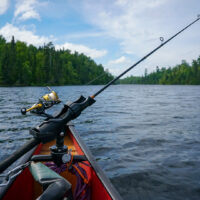
I’ve said it before, and I’ll say it a thousand times again, whether you’re in a canoe or a motor boat, trolling is the name of the game when you’re exploring new waters, areas, or species. This year I decided to explore the art of trolling with a bit more vigor. In doing so, across multiple times of year and weather conditions, I learned that there is absolutely no “one-size-fits-all” approach to trolling.
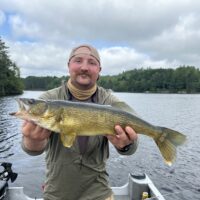
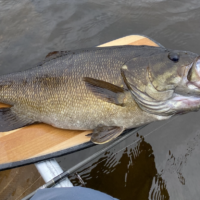
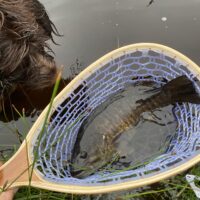
During the Spring, right after the Minnesota walleye opener, I had to slow down my approach significantly for walleye. Rather than pulling crankbaits or even bottom bouncers, I opted for the timeless Lindy Rig with no spinner blades and a hearty live minnow. At a snail’s pace, I would troll along and feel every little dip or bump on the lake bottom. I kept my bail open and my finger on the line so that when a fish bit, I could release the line, count to 3, and set the hook. This resulted in more than a few walleye dinners and one particular 20.5” smallmouth that gave my medium-light rod a run for its money.
Now, cut to September, where the summer and fall temperatures are competing for prominence, I switched gears completely. Rather than slow, methodical trolling of live bait, I would run size 5 – 7 Rapala Shad Raps and/or Tail Dancers between 2-3 MPH. If you’ve spent much time fishing the Midwest, this technique probably isn’t news to you. What I switched up from my usual MO, however, was targeting mid-lake structure. Granted, this is easier to do with a depth-finder in your boat, but it is also perfectly doable with a trusty map!
I like to look for a series of underwater humps that are surrounded by deeper water. For example’s sake, let’s say humps that top out at 10 ft and are surrounded by a 20-30 ft basin. This allows any predatory species like walleye, pike, lake trout, bass, or whatever you’re targeting to follow baitfish over the course of the day. Generally, I catch fish on or near the humps in the morning and evening, and catch them just off the humps during the day. Once you’ve trolled through a few times and have an idea of where they’re centralizing, toss a jig or a slip bobber for some fun and a break from all the paddling or boat steering.
Amphibious Assault
Despite my access to canoes and fishing boats, a very significant number of fish that I caught this year were from shore. During one particular trip in the Boundary Waters, I decided to use them in conjunction with one another.
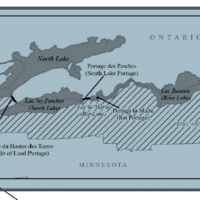
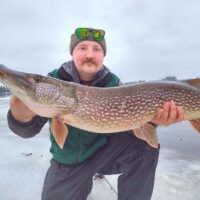
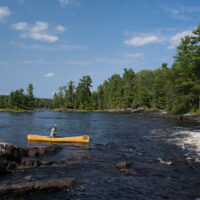
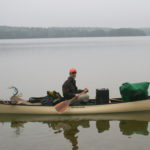
After a wicked paddle across the entire length of Lac La Croix (one of the biggest lakes in the Boundary Waters), we chose a campsite that would set us up for an easy paddle to the next lake the following day. Everyone was tired and not generally interested in fishing, but I kindly asked if I could troll for a bit around the island that we were going to camp on before we hop out and set up. With my fellow paddlers’ approval, I tossed a Rapala off the back of the canoe and proceeded at a steady pace. WHAM! I tied up with a nice pike and it broke off by the canoe. That was all the information I needed. That bite was only about 5 yards or so away from the shoreline and I could tell it was accessible on foot, even if it would take some bushwhacking.
What happened next was nothing short of ridiculous. After setting up camp and getting permission to abandon the rest of my camp duties, I grabbed a couple rods and walked down to where I hooked that pike. I tied on another Rapala, let it fly, and seconds later, WHAM! Pike on and drag running, I fought the great fish only to have it cut the line right in front of my camp crocs. Disappointed to have lost yet another expensive lure, I tied on a ⅛ oz Northland jig and a curly tail (quite possibly the most versatile lure known to man or beast). I made the first cast right on the edge of a cabbage weed patch and before I could even flip the bail over, WHAM! Pike on! As I reeled it in, it cut the line right beneath the rock I was standing on. “Not this time,” I thought as I lunged downward and grabbed the fish out of the water while it tried to swim away.
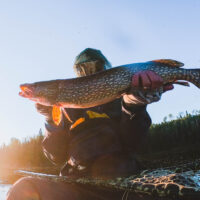
As I grabbed the pike by its gill to remove my jig, I looked in its gullet and saw ALL THREE of my lures! I was so flabbergasted and knew that nobody would believe me, I yelled up to camp, which shortly produced a witness to this great anomaly. Mesmerized by the ravenous nature of northern pike, we took out all the lures and returned him to the cool waters of Lac La Croix. He had earned his freedom after all that and I was stoked to get my lures back. That’s not even my favorite part of this story.
Remembering the patter of softball-sized rocks on my Rapala as we paddled into camp, I moved down the way to a nice point that I could stand on and rigged up a slip-bobber with the leeches I had been carrying in a small Powerade bottle in my fanny pack (Yes, fanny packs are awesome on Boundary Waters trips). I proceeded to catch a stringer of fine eating size walleye from shore in less than 20 minutes. It seemed as though my jig and leech couldn’t even get to the rocky bottom without getting smacked by a hungry specimen. Walking over the big rock outcropping that led to camp, holding a stringer full of tasty fish to share with everyone, was one of the most perfect moments I can think of. It is very unlikely that I would have wandered over and tried that spot had we not fished from the canoe a bit before setting up camp.
Drill, Baby, Drill
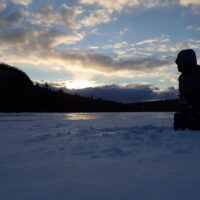
Ice fishing in the Boundary Waters is a truly wild experience and I can’t encourage people enough to try it out if they haven’t already. There is something deeply romantic about pulling a sled across a snow-blanketed lake without a single trace of human existence, wondering with each step what sort of behemoth might be lurking below. Ice fishing in the wilderness area, despite its advantages, comes with one disadvantage: you can’t use a power auger. Let me just say that even if you are in formidable shape and have Paul Bunyan shoulders, drilling hole after hole in 20+ inches of ice can get brutal. Even with the sharpest of blades on the finest of augers, there is no comparison to the ease of an electric or combustion rig.
That being said, you can time your drilling in a way that increases your efficiency, especially if you’re fishing with a partner. First, I like to use the map to find the structure and depth that I think will produce. If I have the luxury of using a mapping system on my phone, I will try to position myself directly over it, but using a paper map can get you pretty close too. Once I’m centrally located in the area I want to try, I will immediately drill three holes in a triangle, about 10 yards from one another, depending on how small or large the structure I’m looking for is. If I have a partner, I’ll have them check the first hole with a flasher as soon as I’m done drilling, so that if our calculations or the map is way off, I don’t need to bother with the other two holes. If the first hole appears to be what we’re after, I’ll have my partner proceed to check them all and we’ll fish for a few minutes if we mark any fish or get any bites. If that spot isn’t producing, I’ll have my partner drill the next three while I continue to fish. This way, we’re maximizing the amount of time a line is in the water while continuing the search.
This leapfrogging method helps prevent any one person from having to drill all the holes, splits up the amount of time you get to fish, and allows you to cover a lot of water. Another thing I enjoy doing is drilling more holes when I have downtime or extra energy. With hands-off rigs like tip-ups and dead-sticks, it only helps you and your group if you drill new holes from time to time. With species like crappie, which sometimes circle around large basins all day, having multiple holes allows you to cover water and have other options when the bite dies off in one particular spot. If everyone occasionally helps drill a hole here and there, the work gets spread around and you’re way more likely to catch more fish and have more fun.
Honorable Mentions:
The following is a list of random fishing tips and tricks I picked up over the year that don’t necessitate a story, but may help on your next trip!
(a) Carry leeches in a tiny screw-cap bottle if you don’t have very much extra space. I have fit up to 3 dozen leeches in a 6 oz bottle before and they were still lively days later. Just change water every so often and keep them out of the sun.
(b) Run bottom bouncers with artificial minnows/grubs. Packing crawlers into the Boundary Waters can be difficult, especially in the summer months. That doesn’t have to stop you from using one of the most effective fishing methods around. I prefer plastics that are low profile to avoid too much spinning. Opt for a heavier bouncer than you may think, as it can sometimes be difficult to go slow on windy days.
(c) Buy or make a lure cover for portaging and pet safety. Nobody likes a treble hook to the hand or pants, and nobody’s dog likes getting a lure stuck in their mouth. For a few bucks, you can purchase or make a simple nylon cover that goes over your rod and lure to avoid snagging anything other than fish by the lips!
(d) Try open water, deep trolling. Many of the deeper Boundary Waters lakes have large populations of cisco, which walleye and lake trout often relate to. If you’re covering a lot of water on these kinds of lakes, consider trolling crankbaits that run 20-30 ft deep over 60-100 ft of water. You might be surprised, especially in the evening. Caution advised, however, you may snag on midlake structure if you’re not careful.
With 2024 in the rearview, I’m constantly trying to improve on the lessons I’ve learned and ways that I can help other people experience the incredible fishing opportunities I’ve had. As we move into the heart of the summer season, my objectives in 2025 are to take even more people fishing that may not go otherwise, learn at least a few new techniques, and of course, try and land that once in a lifetime Boundary Waters monster that, so far, only exists in my dreams.